The Breton crêpe and the Breton galette refer to two distinct preparations, separated by the nature of their flour and their culinary use. The crêpe is made from either buckwheat or wheat flour, sweet or savory depending on the region. The galette, in Upper Brittany, relies exclusively on buckwheat flour, made with water and without eggs in its most traditional version.
Understanding this technical distinction allows one to read a crêperie menu without confusion and to grasp why the taste, texture, and price vary so much from one place to another.
Billig and rozell: the equipment that determines the texture of the crêpe
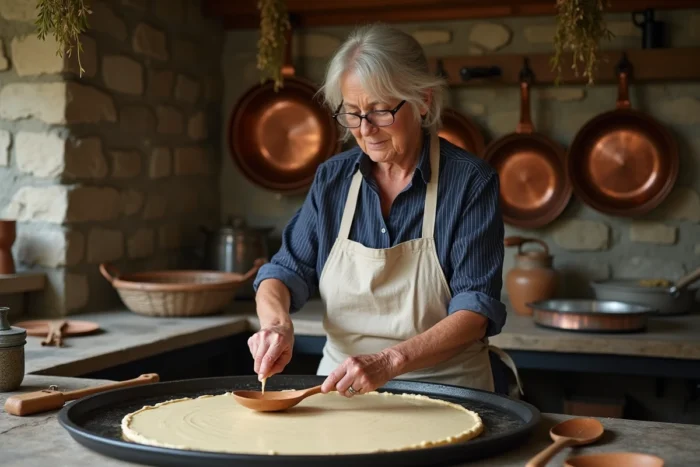
Before discussing batter or filling, the quality of an artisanal crêpe is determined by the cooking plate. In Brittany, this plate has a specific name: the billig. It is a circular cast iron plate, heated by gas or electricity, whose surface reaches high and even temperatures.
The crêpe maker spreads the batter using a wooden rake called a rozell (or rouable). The motion, circular and quick, must be completed in a few seconds. If too slow, the batter cooks unevenly. If too forceful, it becomes too thin and breaks when folded.
The step of seasoning the billig clearly distinguishes the artisan from the beginner. Seasoning a plate involves impregnating it with fat (traditionally butter or lard) through successive heating, until a natural non-stick surface is created. This process takes several days on a new billig. Among the places that perpetuate this artisanal know-how, Little Breizh exemplifies this approach to local crêperies attached to traditional practices.

Buckwheat and wheat: two flours, two batters, two logics
Buckwheat (blé noir) is not a cereal in the botanical sense. It is a seed plant from the polygonaceae family, naturally gluten-free. This absence of gluten has a direct consequence on the batter: it does not develop an elastic network. Therefore, the buckwheat galette is more brittle, drier, and requires a different technique.
The traditional recipe for the buckwheat galette in Upper Brittany consists of only three ingredients: buckwheat flour, water, and salt. No eggs, no milk. This austerity results in a gray batter with a pronounced nutty flavor that cooks very quickly on the billig.
The wheat crêpe, on the other hand, includes eggs, milk, and butter. It produces a soft, golden batter capable of supporting sweet fillings without tearing. In Lower Brittany (notably Finistère), the distinction between crêpe and galette blurs: the term “crêpe” refers to both the savory buckwheat version and the sweet wheat version.
- The traditional buckwheat galette consists solely of buckwheat flour, water, and salt, without eggs or milk.
- The wheat crêpe incorporates eggs, milk, and butter, giving it flexibility and the ability to support sweet fillings.
- Some crêpe makers mix buckwheat and wheat in the same batter to achieve a compromise in texture, but this practice remains controversial among purists.
The origin of the flour changes the taste
The origin of the buckwheat plays a direct role in the aromatic profile of the galette. Flour milled on a stone mill, sourced from a recognized mill in Brittany, develops more complex aromas than industrially imported flour. Several artisanal crêperies now display the name of their supplying mill, much like a restaurant cites its farmer.

Artisanal crêperie fillings: beyond the complete ham-cheese
The most ordered filling in crêperies remains the “complete”: ham, grated cheese, egg. It is a standard, not a gastronomic peak. Local crêperies are increasingly moving away from this.
The rise of an offering labeled “premium” translates into more elaborate fillings: Guéméné sausage sliced on-site, AOP butter (churned butter with Guérande salt), seasonal vegetables from short supply chains, or even artisanal smoked fish. These elaborate crêpes reach significantly higher prices than the simple galette, which remains accessible.
Salted butter distinguishes an artisanal crêperie from a standardized one. In Brittany, butter is traditionally semi-salted or salted, and its quality is perceived from the first bite. Churned butter melts differently on the billig, leaving a finer and more fragrant greasy film than supermarket butter.
- Guéméné sausage, smoked with beech wood, pairs particularly well with a plain buckwheat galette.
- Vegetarian fillings are gaining ground: leek fondue, seasonal mushrooms, local farm goat cheese.
- Breton cider (brut, demi-sec, or doux) remains the canonical accompaniment, served in a bowl.
Local crêperie and tourist crêperie: what separates them
The distinction between these two types of establishments is not a matter of snobbery. It is based on concrete choices regarding sourcing, production, and pricing.
A local crêperie selects its flours from an identified mill, seasons its biligs over time, prepares its batters daily, and adjusts the consistency according to humidity. The batter is never prepared the day before in large quantities.
A tourist-oriented crêperie, often located on the coast or in heavily trafficked city centers, prioritizes volume. The batter may be prepared in advance, the fillings standardized, and the menu price reflects more the location than the quality of the ingredients. Recent inflation in raw materials exacerbates this gap: artisanal crêperies absorb the increase by reducing the menu, while volume crêperies raise prices without changing the offering.
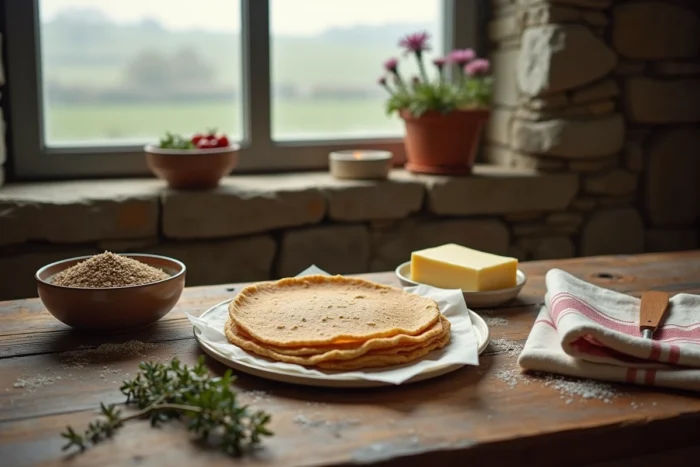
The best indicator remains the menu itself. A crêperie that lists around thirty different fillings rarely works each product with care. A short menu, renewed according to the season, almost always signals an artisanal approach. The cider served in a bowl rather than in an industrial bottle generally confirms this orientation.