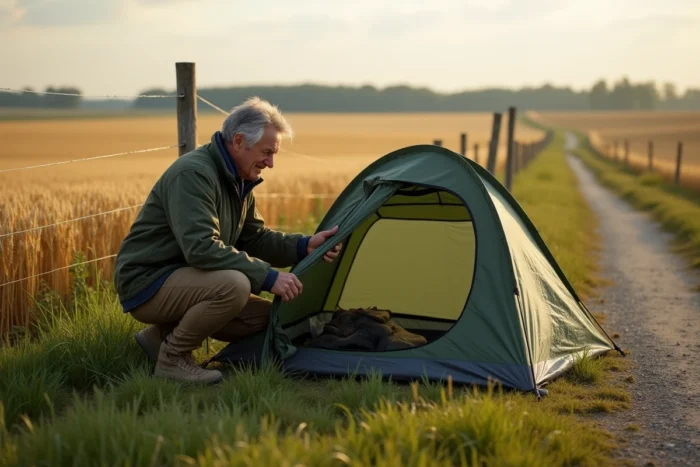
You own an agricultural plot and would like to set up a tent for the weekend or park a caravan for a few days a year. The idea seems simple, but sleeping on agricultural land follows specific rules. The Local Urban Plan (PLU), the Urban Planning Code, and sometimes municipal decrees govern each situation, from occasional bivouacking to the prolonged installation of a mobile home.
The three-month rule on agricultural land: a cumulative threshold often misunderstood
Many owners believe they can freely park a caravan on their land as long as they do not exceed three consecutive months. The reality is stricter. Article R.421-23 of the Urban Planning Code sets a ceiling of three months per year, cumulative periods, even if not consecutive.
In practice, if you set up your caravan for one month in April, one month in July, and one month in September, you reach the threshold. Beyond that, a prior declaration to the town hall becomes mandatory. Failure to declare can lead to a formal notice to remove the vehicle.
This cumulative calculation often surprises owners who use their land seasonally or on weekends. The details of this regulation are elaborated on the Guide Immo website, with the steps to follow based on your situation.
For a tent, the tolerance is practically broader. A one-night bivouac, from sunset to sunrise, is generally accepted on private land with the owner’s consent. However, setting up a tent repeatedly or for an extended period on land classified as agricultural under the PLU poses the same issues as a fixed caravan.

Agricultural zone under the PLU: what the classification really prohibits
A plot classified as zone A (agricultural) in the PLU is not a recreational area. This classification protects the productive purpose of the land. You cannot build freely, and temporary installations are also monitored.
Have you checked the exact zoning of your plot? The urban planning document of your municipality distinguishes several subcategories. Some zone A areas allow constructions related to agricultural operations (sheds, livestock buildings). Others do not allow anything at all.
The case of STECAL
The Limited Size and Capacity Sectors (STECAL) constitute a notable exception. This provision allows municipalities to delineate, within an agricultural or natural zone, micro-sectors where certain installations are permitted. A farm campsite or unusual accommodations (cabins, yurts) can find a legal basis there.
The problem: not all municipalities provide for STECAL in their PLU. And when they do, the areas concerned remain very limited. You need to consult the PLU regulations at the town hall or on the urban planning geoportal to find out if your plot is affected.
Caravan, mobile home, tent: each type of installation has its own constraints
The law does not treat a lightweight tent, a wheeled caravan, and a mobile home placed on the ground in the same way. Here are the distinctions to know:
- The tent: no formalities for an occasional one-night bivouac on private land with the owner’s agreement. Beyond that, the repetitive or prolonged nature can be reclassified as unauthorized camping.
- The caravan: retains its status as a vehicle as long as it keeps its wheels and remains mobile. Free parking for up to three cumulative months per year, prior declaration beyond that (Article R.421-23 of the Urban Planning Code).
- The mobile home: considered a mobile leisure residence. Its installation on agricultural land is prohibited outside of developed sites (campsites, PRL). Removing the wheels or placing it on blocks worsens the situation by turning the mobile home into a de facto construction.
This distinction may seem subtle, but it changes everything legally. A mobile home placed “temporarily” on an agricultural plot exposes its owner to a report of violation of the Urban Planning Code.
Farm camping and municipal decrees: traps to check before sleeping
Some farmers welcome campers on their land as part of farm camping. This arrangement is legal, but it requires a declaration at the town hall and compliance with specific conditions: a maximum of six pitches and twenty campers simultaneously for a declared campsite.
If you are not a farmer, you cannot rely on this regime. And even as a farmer, local restrictions may apply.
Seasonal municipal decrees
Several municipalities issue decrees prohibiting camping, bivouacking, or parking recreational vehicles in natural, agricultural, and wooded areas during the summer. These prohibitions aim to prevent fires and protect sensitive environments.
A decree of this type has been issued, for example, in La Flotte (Charente-Maritime) to prohibit camping in the natural, agricultural, and wooded areas of the municipality. These decrees apply even on private land, which surprises many owners.
Before any installation, check with your town hall:
- The PLU zoning of your plot (zone A, N, or presence of a STECAL)
- The existence of seasonal or permanent municipal decrees limiting camping
- Any environmental easements (proximity to a watercourse, Natura 2000 area, catchment perimeter)
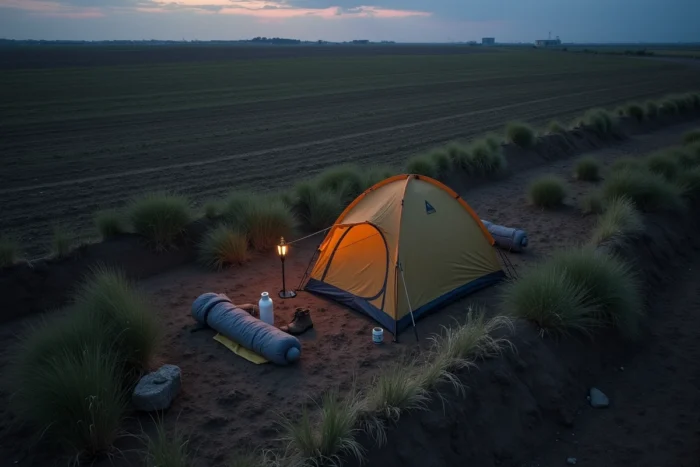
The temptation to discreetly settle on agricultural land is understandable, especially when the plot seems isolated and unused. But checks exist: reports from neighbors, aerial surveys for the CAP, visits from the municipal police. A violation of the Urban Planning Code can lead to a fine and the obligation to restore the land at your expense.