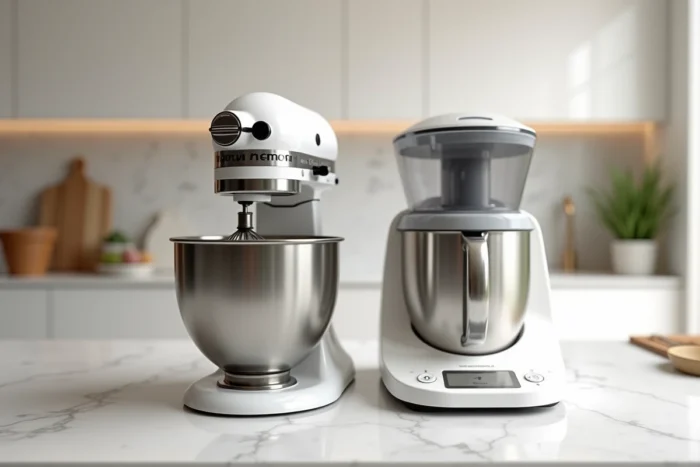
The stand mixer and the Thermomix occupy adjacent niches in the kitchen but cater to very different preparation logics. One kneads, whips, and beats with a planetary motion designed for baking. The other mixes, heats, steams, and guides step-by-step via a connected screen. Comparing these two devices without asking the right questions often leads to a disappointing purchase.
Integrated cooking vs. planetary motion: two philosophies of appliances
The Thermomix is a multifunctional cooking robot. Its heating bowl, steam cooking programs, simmering, and mixing capabilities make it an appliance geared towards the complete preparation of a meal. The latest model, the TM7 launched in 2025, introduces a lidless cooking mode that allows for reductions, caramels, or searing just like on a real pot.
The stand mixer, on the other hand, does not heat. Its strength lies in its planetary motion and kneading power. A hook, a whisk, a paddle: these three accessories cover almost all baking needs, from whipping egg whites to kneading yeast dough.
For anyone who regularly prepares brioche, bread dough, or meringues, this mechanism remains difficult to match with a cooking robot whose bowl and blades are not designed for these textures.
A detailed analysis of the choice between stand mixer or Thermomix on Cookinette helps to better understand the specific uses of each appliance before making a decision.
Brioche dough, risotto, steaming: what concrete results to expect
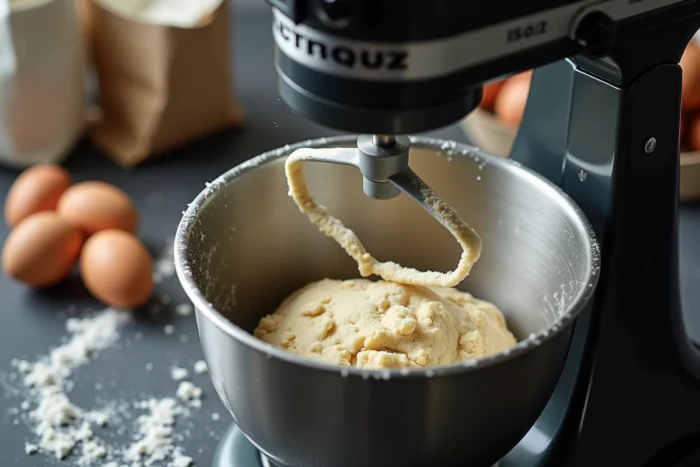
Field feedback diverges on one specific point: the Thermomix’s ability to replace a stand mixer for heavy doughs. The Thermomix bowl, designed for mixing and cooking, handles pancake or sponge cake batter correctly. However, a brioche dough that requires long and progressive kneading puts the motor to the test and often produces a result that is less airy than with a planetary mixer.
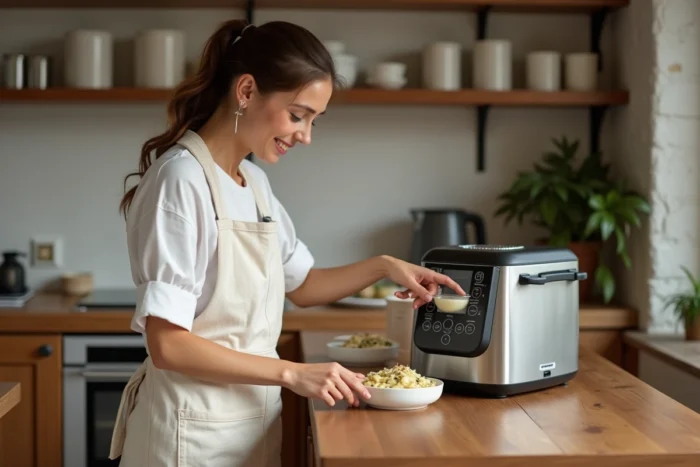
Conversely, the stand mixer does not cook anything. Risotto, a velvety soup, a simmered dish: these preparations are completely beyond its capabilities. The Thermomix has the advantage here with its guided cooking programs and integrated recipes via the Cookidoo platform, which offer step-by-step assistance.
Preparations where the Thermomix has no pastry equivalent
- Simultaneous steaming (vegetables, fish) while a dish simmers in the main bowl, thanks to the stacked steaming basket
- Emulsified sauces cooked hot (béchamel, crème anglaise) with precise temperature control
- Grinding powdered sugar, dried fruits, or spices, which is impossible with a planetary whisk
Preparations where the stand mixer remains superior
- Kneading firm doughs (bread, pizza, inverted puff pastry) that require prolonged mechanical work without overheating
- Whipping buttercream or Italian meringue, where the planetary whisk incorporates air in a consistent and gradual manner
- Using optional accessories (meat grinder, citrus juicer, pasta roller) that expand the scope well beyond baking
Noise, footprint, and maintenance: criteria that comparisons overlook
The TM7 has introduced a motor touted as “hyper silent”, which represents a notable change compared to previous generations, often criticized for their noise level in grinding mode. Feedback on this point is still recent, and the available data does not yet allow for conclusions about the actual difference with a classic stand mixer in operation.
Footprint is a factor often underestimated. The Thermomix, with its bowl, lid, steaming basket, and screen, occupies a significant amount of countertop space. A stand mixer like KitchenAid or Kenwood also takes up space, but its bowl stacks more easily, and the appliance sometimes serves as a permanent decorative element in the kitchen.
For maintenance, the Thermomix bowl cleans in seconds with hot water and a drop of dish soap run in turbo mode. The stand mixer requires disassembling the whisk or hook, followed by a separate wash of the bowl, often dishwasher compatible. The Thermomix clearly wins on the speed of daily cleaning.
Actual budget of a stand mixer compared to the Thermomix
The Thermomix is positioned in a price segment significantly higher than most stand mixers, including high-end models. The exclusive distribution method (direct sales or online via Vorwerk) maintains a stable price, without seasonal promotions comparable to those practiced on stand mixers in supermarkets or online.
An entry-level stand mixer costs several times less than a Thermomix. Mid-range models from Kenwood or KitchenAid fall within an intermediate price range. The budget question is not limited to the purchase price: the optional accessories for the stand mixer can double the bill if one adds a meat grinder, a pasta roller, and a blender.
For the Thermomix, the Cookidoo subscription (guided recipe platform) represents a recurring cost to factor into the calculation. Without this subscription, the device remains functional but loses much of its appeal for users who rely on step-by-step guidance.
The choice between these two appliances is not just a list of functions. A regular cook who prepares complete meals during the week will benefit more from the Thermomix. A baking enthusiast who kneads every weekend will find in the stand mixer a tool that the Thermomix does not truly replace. Buying both remains the only option that covers all needs, which many amateur cooks equipped for several years already do.