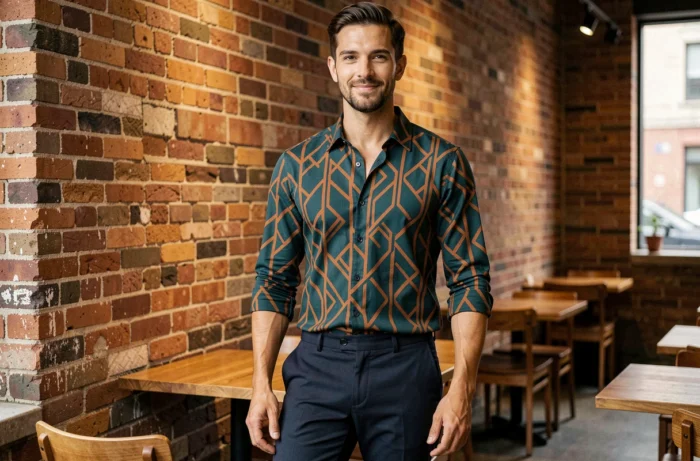
The original shirt is not just a flashy print slapped onto low-quality poplin. The choice of weave, collar construction, and placement of patterns determine whether a piece truly asserts a style or falls into the realm of costume. For several seasons now, we have observed a shift towards original men’s shirts that combine textile technicality with a bold aesthetic choice.
Collar construction and finishes: what separates the original from the fanciful
A poorly proportioned collar neutralizes any bold pattern. On a shirt with strong patterns (oversized flowers, asymmetrical checks), the collar must visually balance the density of the design. A cutaway collar with removable stays provides the necessary rigidity to structure the upper torso without overwhelming the pattern.
Interior finishes are just as important as the exterior. A well-constructed original shirt features flat-felled seams at the armholes, with no visible overlocking. The use of contrasting fabric under the collar or inside the button placket is a marker of a well-crafted piece, provided the contrast remains within the same chromatic family as the main pattern.
We recommend systematically checking the thickness of the collar interfacing: if it’s too thin, it will deform after a few washes, and the shirt will lose all its shape. If you’re looking to discover original men’s shirts that stand the test of time, this is the first point to inspect in-store or on a detailed product sheet.
Autumn-Winter 2026 plaid flannel: the casual pattern that reinvents itself
The plaid pattern remains the dominant casual motif for relaxed shirts. The autumn-winter 2026 trend refocuses it on flannel, in red, burgundy, and brown tones that replace the saturated multicolored tartans of previous seasons. This narrowing of the palette gives the plaids a more mature look, making them easier to integrate into a structured outfit.
Flannel provides a brushed touch that alters the perception of the pattern. An identical plaid woven in poplin will appear more graphic and formal; in flannel, it gains depth and visual softness. The weight of the flannel also affects the drape: if it’s too light, the fabric will ripple at the side seams. A sufficiently dense weight ensures a clean silhouette even when worn open over a t-shirt.
Pairing plaid flannel without a lumberjack effect
The classic pitfall is wearing plaid flannel with raw denim and boots, which locks the look into a predictable workwear register. To assert an original style, we observe that contrasting registers work better:
- Burgundy plaid flannel tucked into medium grey wool pleated trousers, with a slim matte leather belt
- Open flannel shirt over a fine turtleneck, paired with an unstructured suit without lining
- Rolled sleeves two turns above the wrist to lighten the visual mass of the brushed fabric
The common thread: mixing flannel with more dressed-up pieces to create a stylistic tension that breaks away from the predictable.
Flowered shirts and printed patterns: density and scale of the design
Floral patterns operate on a principle rarely articulated in fashion guides: the scale of the pattern must correspond to the wearer’s build. A man with a narrow build will wear a small-scale floral pattern (micro-flowers, liberty) better, as it does not create visual distortion. A broad build can support oversized flowers without the pattern appearing compressed.
The density of the pattern plays a comparable role. A dense floral print (a background fully filled with colors) behaves visually like a solid color from a distance. A sparse print on a light background draws more attention to each element of the design. For a truly original shirt, the second choice requires more mastery in the rest of the outfit: solid trousers, neutral color, discreet accessories.
The trap of tropical prints worn out of season
Tropical patterned shirts (palm leaves, hibiscus) remain confined to warm months. Worn in autumn-winter with a blazer, they create a seasonal mismatch that reads not as a stylistic choice but as a casting error. Abstract or geometric floral patterns offer the same visual energy without seasonal anchoring, making them wearable across a much broader range.
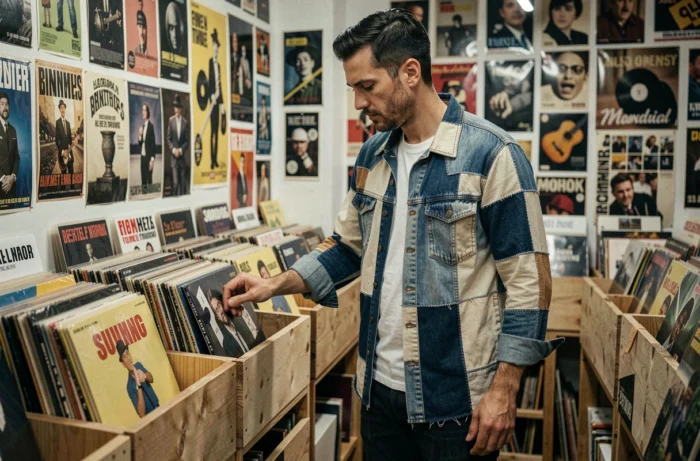
Fitted cuts 2026 and cotton choices: silhouette and comfort
Fitted cuts are making a strong comeback in 2026, after several seasons dominated by oversized or boxy silhouettes. This return does not mean a return to the extreme slim fits of the 2010s. The current cut retains a few centimeters of ease at the bust while tightening the sleeves and slightly shortening the body length.
The choice of cotton directly affects comfort in these closer-fitting cuts. A twill cotton offers a slight natural stretch without the addition of elastane, preserving breathability. A stiffer oxford cotton requires precise measurement adjustments to avoid tension creases at the shoulder blades.
- Twill cotton: fluid drape, suitable for patterned shirts that require a soft drape to read the design well
- Oxford cotton: texture visible to the naked eye, ideal for solid or finely striped shirts that play on the material rather than the pattern
- Poplin cotton: smooth and lightweight surface, favored for dress shirts to be worn under a suit
The fabric alters the perception of the pattern just as much as the color. The same floral print on poplin and on oxford does not produce the same effect at all. Testing the pattern on the actual fabric, and not just on a screen, remains the best reflex before purchase.
The return of more structured shirts in 2026 reflects an underlying movement: the original shirt is no longer defined solely by its print, but by the balance between cut, material, and pattern. A piece that masters these three parameters does not need to overdo it to stand out.