An imported decorative object is not just a simple trinket placed on a shelf. It is a concentration of craftsmanship, local materials, and aesthetic codes specific to a region of the world. Decorating your interior with objects from elsewhere requires understanding what distinguishes an authentic handmade piece from an industrial reproduction, and mastering a few rules to integrate these elements without turning your living room into a tourist bazaar.
Traceability of materials: what the European regulation changes for imported decorative objects
Before discussing aesthetics, a technical point deserves to be made. The traceability of wood is becoming a major regulatory criterion for imported furniture and decorative objects in Europe. The European regulation on deforestation requires demonstrating that the wood used does not come from deforested land after December 31, 2020, with a mandatory due diligence declaration.
The main obligations will apply starting December 30, 2026. In practical terms, a carved stool brought back from Bali, a teak tray purchased online, or a frame made of exotic wood ordered from a South American artisan could all be affected.
On bazaaretcompagnie.com, product sheets provide information about the origin of materials and the type of manufacturing, which facilitates this verification before purchase.
At the same time, the digital product passport, created by the European regulation on eco-design adopted on June 13, 2024, will gradually apply to furniture. This system will document the characteristics, durability, and repairability of objects. Furniture is among the first categories targeted by the European work plan 2025-2030.

Raw materials and imperfect finishes: recognizing an authentic handmade object
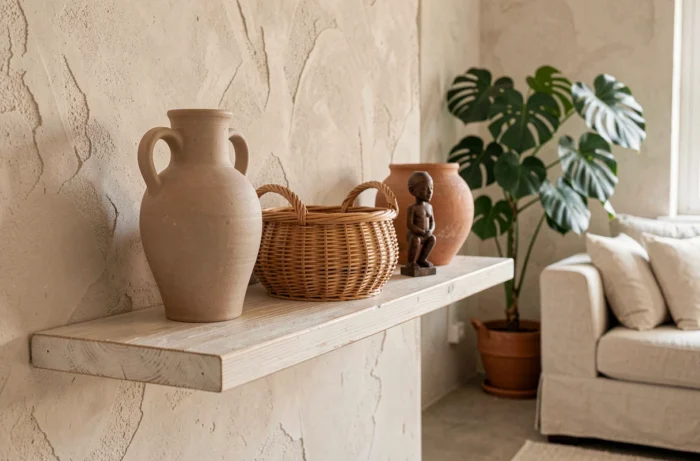
Current decoration trends value pieces that bear visible traces of craftsmanship rather than perfectly uniform finishes. A stoneware vase with slight variations in glaze, a handwoven fabric with irregularities in weave, a pottery piece whose shape is not perfectly symmetrical: these imperfections signal manual work and not a defect.
To distinguish a handmade piece from an industrial imitation, three concrete criteria help to decide:
- Weight: an object made from raw material (thick ceramic, solid wood, forged metal) weighs significantly more than a copy made of resin or MDF covered with veneer
- Joints: on a hand-assembled piece of furniture, the tenons, dowels, or welds remain visible, whereas mass production hides them under a coating or plastic joint
- Patina: an object made of brass, copper, or untreated wood develops a natural patina over time, indicating that the material has not been covered with a synthetic varnish blocking aging
This attention to raw materials aligns with a broader trend. Authenticity is now measured by the repairability and lifespan of an object, not just its artisanal appearance. A restored piece of furniture or a second-hand item with acknowledged signs of use fits into this logic.
Integrating objects from around the world into an interior without a travel catalog effect
The classic trap is to accumulate objects from different origins without a coherent palette or proportion. The result then resembles an airport shop display.
Limit the color palette to three tones
An African mask with ochre pigments, a Berber rug with cream and earth patterns, a cushion in Japanese indigo: these three color families are enough to create harmony. Adding a fourth strong color (an Indian emerald green, a Mexican red) creates a visual overload in most living spaces.
Each imported object works better as an accent than as a dominant. A single wall textile with geometric patterns is sufficient in a living room. The rest of the furniture and accessories benefit from remaining understated so that the centerpiece can breathe.
Play with proportions and heights
A large floor vase, a collection of small ceramics displayed high on a shelf, a woven basket placed under a coffee table: varying the sizes avoids the “collection in a row” effect. The basic rule is to never align more than three objects at the same height on the same visual plane.

Trendy objects and craftsmanship to watch in interior decoration
Some handmade objects are gaining visibility thanks to social commerce and digital customization platforms, which allow discovering artisans who were previously invisible outside their local market.
The most sought-after pieces combine functional design and identifiable manual craftsmanship. Among the rising categories:
- Workshop ceramics (Japan, Portugal, Morocco): bowls, serving dishes, and vases with irregular glazes, usable on a daily basis
- Handwoven textiles (India, Guatemala, Ethiopia): throws, table runners, and cushions whose patterns vary from piece to piece
- Restored furniture and vintage objects: antique furniture refurbished using traditional techniques, often mixed with contemporary elements
- Natural fiber lighting (rattan, bamboo, raffia): pendants and table lamps whose structure allows light to filter diffusely
The common thread among these categories is the traceability of the manufacturing process. An informed buyer can trace back to the workshop or cooperative that produced the object, which serves as both an ethical guarantee and a style argument.
Interior decoration with objects from elsewhere is not just an aesthetic choice. The European regulatory framework on imported materials and the rising demand for sustainability are gradually transforming the market. Choosing an authentic handmade piece means documenting its origin, verifying its composition, and ensuring it will age as well as the craftsmanship it represents.