
The online beauty market has become the second largest e-commerce category in Europe, just behind food, according to a NielsenIQ analysis from June 2026. This rapid progression is reshaping how consumers choose their skincare, makeup, and perfumes. Understanding the mechanisms that structure this market allows for more thoughtful purchases and helps avoid certain marketing traps.
Anti-greenwashing directive: what changes for online beauty products
The European directive (EU) 2024/825, known as “Empowering Consumers for the Green Transition,” will apply across the European Union starting September 27, 2026. Its goal is to prohibit generic environmental claims on product listings and packaging.
Specifically, terms like “eco,” “green,” “sustainable,” or “environmentally friendly” will no longer be allowed on a cosmetic product sold online without official certification recognized by an independent body. Stores that do not comply with this regulation face criminal penalties.
For buyers, this directive represents a useful filter. Before confirming a purchase, checking for the presence of a specific label (Ecocert, Cosmos, Nordic Swan) rather than a simple “natural” mention on the product listing becomes a habit to adopt. Platforms that anticipate this transition are already structuring their catalogs around certification filters, making navigation easier. It is also possible to access shopping on Babioles Beauté to view a selection organized by category of skincare and makeup.
Face care and makeup: the formulations dominating the online market
Beauty product trends are not limited to seasonal colors. The real dynamics are played out in the formulations and active ingredients claimed in product listings.
Face care accounts for the majority of online searches. Acid-based serums (glycolic, salicylic, hyaluronic) remain the most consulted products on specialized platforms. Their success is due to a measurable promise: skin texture, hydration, radiance.
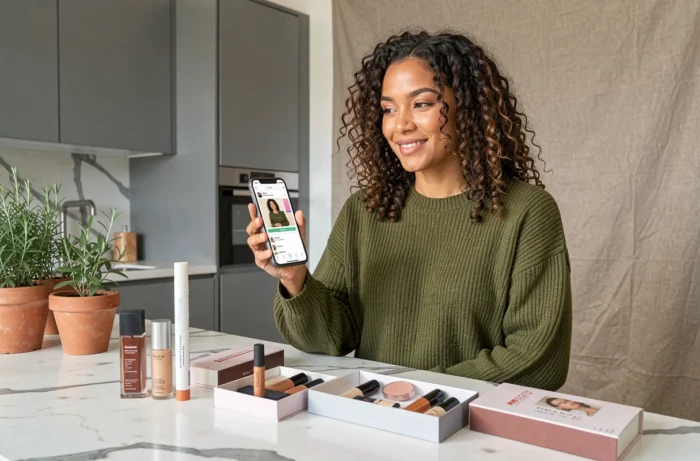
In makeup, foundations and concealers now come in very broad ranges of shades. Brands that offer online diagnostic tools (skin tone quizzes, virtual camera try-ons) experience lower return rates, benefiting both the customer and the seller.
Criteria to check before an online cosmetic purchase
- The complete INCI list must be accessible on the product listing, not just the three active ingredients highlighted by marketing.
- Customer reviews mentioning the buyer’s skin type provide more reliable information than an overall rating out of five stars.
- The actual volume (in milliliters) allows for price comparison by volume between two similar products, a reflex that visual presentations on sites do not always facilitate.
Online perfumes: buying without testing, the limits of the model
Perfume remains the most delicate category to buy online. The absence of olfactory testing drives buyers towards safe bets, concentrating sales on a few dozen well-known references.
Several platforms circumvent this difficulty by offering discovery formats (samples or miniature sets). This model reduces financial risk and allows exploration of less publicized brands.
Another lever appears with detailed olfactory descriptions. Product listings that specify top, heart, and base notes, accompanied by concrete comparisons (“dry woody close to vetiver, without the sweet roundness”), help more than a simple classification by family (floral, oriental, chypre).
Beauty loyalty programs: understanding the points mechanics
Most online beauty retailers operate with a points system that can be converted into discounts. Not all loyalty programs are equal in terms of actual return on purchase.
To evaluate a program, three parameters matter:
- The points/euro spent ratio, which varies by retailer. Some programs award one point per euro, others five, but the conversion threshold also differs.
- The validity period of points: a program that expires points after six months encourages unplanned purchases.
- Benefits beyond discounts (early access to new products, free shipping, exclusive samples) sometimes represent greater value than direct discounts.
The retailer’s mobile app also plays a role. Notifications about point accumulation or targeted promotions based on purchase history increase purchase frequency, which is not always in the customer’s best interest.
Comparing prices between beauty retailers in France
The same branded product can show significant price differences from one platform to another. These differences are explained by commercial agreements between distributors and brands, shipping costs included or not, and temporary promotions.
Checking the price per milliliter remains the most reliable comparator. Sets and limited editions can obscure the reading: a discounted set may contain sizes too small to be truly advantageous.
General marketplace platforms (like Amazon) sometimes offer lower prices than specialized retailers, but the traceability of the product raises questions. Cosmetics sold by third-party sellers do not always benefit from the same storage and expiration date guarantees as those distributed through the brand’s official channels.
The reconfiguration of the online beauty market, between regulatory pressure on greenwashing and the rise of marketplaces, is permanently changing shopping habits. The directive of September 27, 2026, will force retailers to clarify their claims, which should simplify sorting for buyers attentive to the actual compositions of their products.