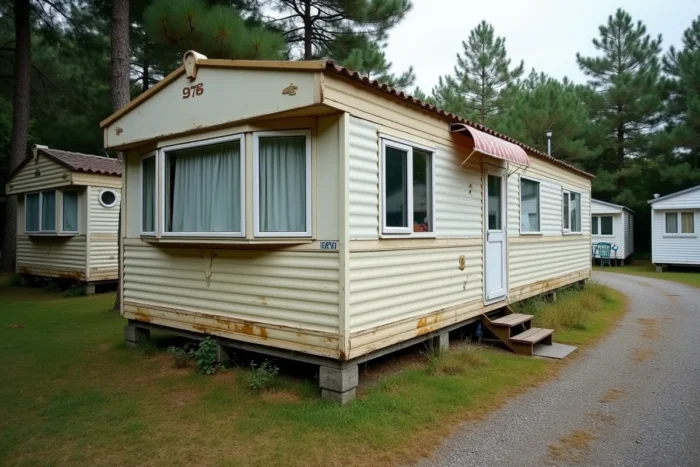
A mobile home installed for over twenty years on a camping plot often generates a specific concern: can the manager demand its removal or replacement by invoking a legal text? The answer relies less on national legislation than on the combination of the site rental contract, the camping’s internal regulations, and the urban planning standards applicable to mobile leisure residences.
Decree 2026-14 on site rental contracts: what changes for older mobile homes
Competing articles on this subject overlook a recent development. Since January 16, 2026, decree n° 2026-14 imposes enhanced obligations on camping managers regarding site rental contracts: duration, termination procedures, pre-contractual information, and regulation of rent increases.
For owners of older mobile homes, the impact is direct. A clause allowing termination or non-renewal of a contract solely due to the age of the mobile home must now align with these new formal obligations. A manager invoking obsolescence without adhering to the formalities of the decree is subject to contestation.
Understanding the law on mobile homes over 20 years old requires distinguishing between what falls under national law (Tourism Code, Urban Planning Code) and what pertains to the private contract signed with the camping.
Mobile home over 20 years old: national legal framework and camping regulations
No French law imposes an age limit for a mobile home installed in a camping or residential leisure park. The Tourism Code does not mention any obsolescence threshold related to age. The Urban Planning Code regulates the conditions for installing mobile leisure residences, not their lifespan.

Decree n° 2007-18 of January 5, 2007, defines the mobile home as a mobile leisure residence (RML) intended for temporary or seasonal occupation. To maintain this status, the mobile home must retain its means of mobility (wheels and towing bar) and not be anchored to the ground. These criteria do not change with age.
| Source of the rule | What it says about age | Consequence for a mobile home over 20 years old |
|---|---|---|
| Tourism Code | No mention of an age limit | No legal obligation for removal |
| Urban Planning Code (decree 2007-18) | Defines the RML by its mobility, not by its age | The mobile home remains an RML as long as it retains wheels and a towing bar |
| Site rental contract | May contain an obsolescence clause | Only document that can impose a replacement related to age |
| Campsite internal regulations | May set criteria for condition or aesthetics | Applicable if the owner has contractually accepted it |
The confusion arises from the fact that many camping managers present the twenty-year limit as a regulatory obligation. In reality, this limit falls exclusively under the private contract between the owner and the camping.
Obsolescence clause in the site contract: what is enforceable
The site rental contract is the only document capable of imposing an age-related constraint. Three elements determine whether this constraint is enforceable.
- The clause must be explicitly stated in the contract signed by the owner, not just in an internal regulation modified after signing.
- It must specify the objective criteria justifying replacement: general condition, compliance with safety standards, external appearance. A clause requiring replacement solely due to age, without condition criteria, may be deemed abusive.
- Since decree 2026-14, termination procedures must adhere to enhanced formalities: prior information, notice period, written justification. A non-renewal notified without adhering to these conditions opens up a recourse.
On the other hand, a contract that clearly ties replacement to verifiable condition criteria and adheres to the current formalities remains enforceable, even if the mobile home has been well maintained.
Safety standards and obligations for owners of older mobile homes
The age of a mobile home is not a legal criterion for removal, but safety condition is. Electrical and gas installations must remain compliant with current standards. A mobile home over twenty years old whose electrical system has never been checked poses a real problem, regardless of any contractual clause.
The good general condition of the mobile home remains the best argument against a manager invoking obsolescence. An owner able to present maintenance invoices, a recent gas installation check, and a watertight roof has concrete elements to contest a non-renewal.

Campsite managers must also comply with enhanced safety standards for their entire establishment. The 2026 camping regulations impose increased obligations regarding fire safety and accessibility. A camping that demands the replacement of an old mobile home for aesthetic reasons while failing to bring its own facilities up to standard exposes itself to symmetrical argumentation.
Installation of an old mobile home on private land: urban planning and taxation
Moving a mobile home over twenty years old onto private land does not exempt one from urban planning rules. The installation of a mobile leisure residence on private land requires prior declaration, or even a development permit depending on the area and duration of occupation.
- An installation of less than three months per year on private land generally requires no authorization, provided the land is not located in a protected area.
- Beyond three months, a prior declaration to the town hall is required. The local urban planning plan (PLU) may prohibit the installation of RML in certain areas.
- A mobile home installed year-round on private land loses its status as a mobile leisure residence and may be reclassified as a construction subject to a building permit, with the associated tax consequences (housing tax, property tax).
The tax status of a mobile home in a camping differs: as a movable property, it is not subject to property tax. Housing tax may apply if the mobile home constitutes a secondary residence, depending on the municipalities.
The absence of national law on the age of mobile homes does not mean the absence of constraints. The site contract, decree 2026-14, and safety standards form a three-tiered framework. An owner of an older mobile home who checks their contract, documents the maintenance of their installation, and knows the manager’s obligations has the necessary levers to defend their position.