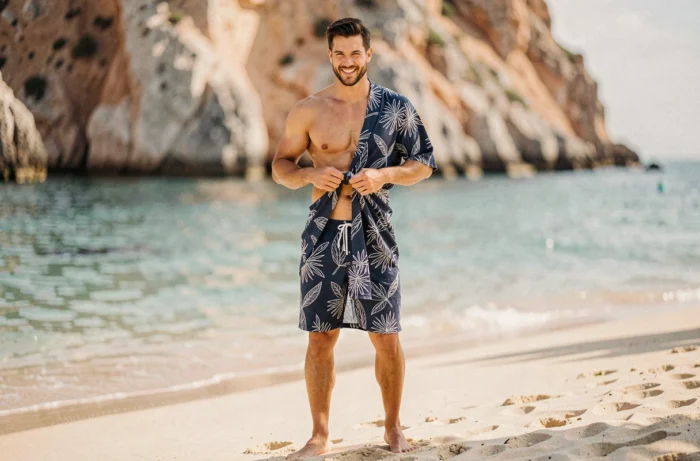
The men’s pareo refers to a rectangle of lightweight fabric, usually cotton, viscose, or linen, tied around the waist or hips. Far from being just a beach accessory, this piece is making its way into the spring-summer 2026 collections, worn both bare-legged and over pants. Understanding the basics of tying and clothing combinations allows you to exploit its full potential, from the seaside to the city terrace.
Fabric and dimensions: choosing a pareo suited to the male physique
The choice of fabric determines the drape and hold of the knot. Lightweight cotton wrinkles quickly but absorbs moisture, making it practical after swimming. Viscose offers a more fluid drape and a slightly satin appearance, suitable for summer evening outfits.
Linen, being stiffer, holds better in place once tied and withstands repeated washing. For versatile use, blended viscose remains the best compromise between structure and fluidity.
In terms of dimensions, a pareo that is too short limits tying options. For an average-sized man, a fabric of at least 180 cm long and 100 cm wide allows for most ties without running out of material. Broader physiques benefit from opting for a greater width to maintain a comfortable overlay at the thighs.
Knowing how to wear a men’s pareo first relies on these fabric and size parameters, which determine the strength of the knot as well as the final style.
Three men’s knots that really stay in place
The majority of tutorials present knots designed for feminine silhouettes. When applied as is to a male body (narrower, without a pronounced hip curve), these knots slip. Three techniques work reliably.
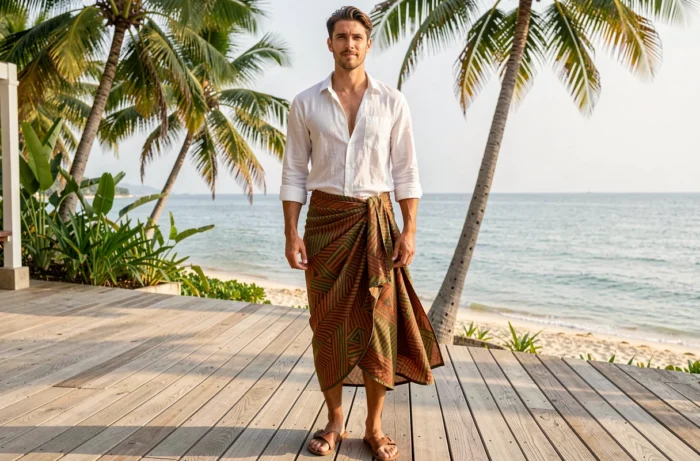
The waist skirt knot
Place the pareo behind you, bring the two ends to the front, cross them over your belly, and tie them at the side of your hip. The side knot prevents the fabric from slipping forward when you walk. Adjust the height: above the navel for a traditional sarong effect, at the hips for a more relaxed drape.
The low hip tied beach drape
Fold the pareo in half lengthwise to reduce its width. Wrap it around your hips starting from the back, then make a double flat knot on the side. This knot creates a kind of loose shorts, practical for moving on the sand or going from the sun lounger to the beach bar.
The Polynesian rolled tie
Roll the upper edge of the fabric over itself two or three times before tying it. This roll creates an integrated belt that enhances the hold. This technique is commonly used during Tu’aro Ma’ohi (traditional Polynesian sports) for its sturdiness, even in motion.
- Cotton or linen: prefer the double knot, as the stiff fabric loosens less easily.
- Viscose or silk: a simple knot is sufficient, but rolling the upper edge is still recommended to prevent slipping.
- Thin and slippery fabric: adding a small discreet flat pin on the inside secures everything without breaking the line.
Wearing a men’s pareo beyond the beach: combinations and urban style
The 2026 trend pushes the men’s pareo towards a use that Anglo-Saxons call sarong-skirt styling: the fabric is treated as an urban-style skirt, not just a simple swimsuit cover-up. The Dries Van Noten spring-summer 2026 show showcased pareos worn over straight pants, tied at the waist, combined with structured tops.
Specifically, three combinations work outside of the sand:
- Pareo tied at the waist over wide linen pants, with an open poplin shirt. The layering creates a play of volumes without overloading the silhouette.
- Pareo worn as a mid-calf skirt with a fitted t-shirt and leather sandals. The contrast between the fitted top and the fluid bottom structures the outfit.
- Short draped pareo (above the knee) paired with an unlined blazer and loafers. This combination transposes the pareo into a semi-formal register suitable for summer dinners.
The choice of colors and patterns directly influences the readability of the outfit. A solid-colored pareo in a neutral shade (sand, khaki, navy) easily integrates into an existing wardrobe. Tropical patterns or batik prints work better when the rest of the outfit remains understated.
Hybrid versions and pre-structured pareos: an alternative to free fabric
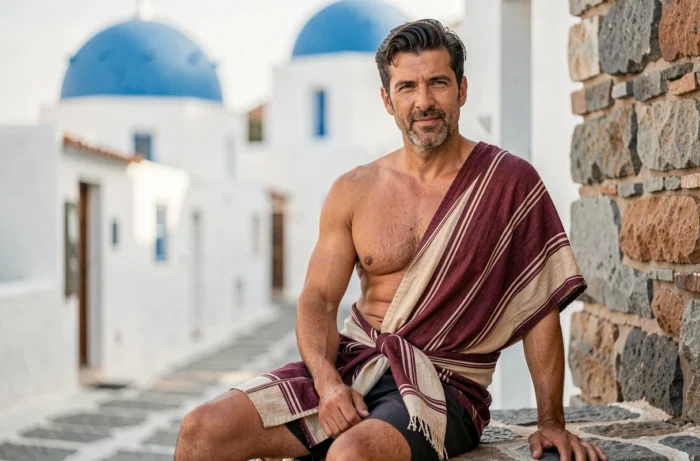
Men’s fashion brands now offer pre-structured pareos with integrated fastening systems: hidden snap buttons, elastic bands sewn into the upper edge, or sliding ties. These hybrid versions are closer to ready-to-wear and meet a demand for practicality, especially among men who are not used to tying.
The main advantage is the quick donning and stability of the hold, even in motion. The downside: these models offer less versatility than a rectangle of free fabric, which can transform into a scarf, towel, or picnic blanket.
For a first purchase, a classic free fabric pareo remains the most versatile choice. A single well-chosen pareo replaces three pieces in a summer suitcase, provided you master two or three basic knots. Pre-structured versions are more suitable for those looking for a fixed garment, worn exclusively as a skirt.
The men’s pareo today sits at the crossroads between a travel accessory and a fully-fledged fashion piece. The fabric you choose, the height at which you tie it, and the clothes you wear with it define the style, from the casual beach sarong to the structured urban drape.