The ring of a deceased parent is not just any piece of jewelry. An intimate object, imbued with a marital history that predates our own, it raises a question that few guides address directly: what does it mean, concretely, to wear a ring that sealed the union of one’s parents? Between divergent religious traditions, family customs, and material constraints (size, metal, condition of the ring), the factors to consider are more numerous than they seem.
Religious and cultural traditions: what each framework allows or discourages
The act of wearing the ring of a deceased loved one is interpreted differently depending on the cultural or religious context. The table below summarizes the most common positions.
| Framework | Position on wearing the ring of a deceased parent | Condition or nuance |
|---|---|---|
| French Catholic tradition | No formal prohibition | The ring is not a consecrated liturgical object; it remains a family possession |
| Judaism (halakha) | Allowed with reservations | Some authorities recommend verifying the kashrut of the metal or resizing the ring to distinguish it from the original |
| Islam | No explicit prohibition on wearing inherited jewelry | The honor of deceased parents (birr al-walidayn) includes preserving their personal belongings |
| Contemporary secular usage | Increasingly accepted practice | The choice of finger and hand varies depending on whether one wishes to distinguish the gesture from a personal marital commitment |
The decision to wear the ring of one’s deceased parents thus falls within a space where individual freedom prevails, provided one understands what the gesture communicates within their own family and religious environment.
Which finger and hand for an inherited ring
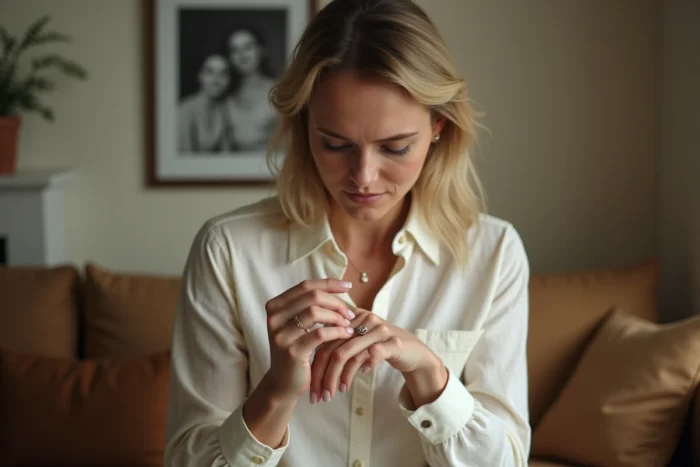
In France, the wedding ring is traditionally worn on the left ring finger. Wearing that of a parent on the same finger can create confusion, especially if one is married. The right ring finger is the most common choice to clearly mark the distinction between personal commitment and filial tribute.
Other options exist. Some wear the ring as a pendant on a chain close to the heart. Others slide it onto the pinky or middle finger, depending on the size of the ring. The chosen finger has no normative value: what matters is the coherence with one’s own intention.
- Right ring finger: clearly distinguishes tribute from marital commitment; this is the most common practice among non-widowed individuals
- Pendant on a chain: discreet, suitable when the ring is too small or too large to be worn on the finger
- Pinky or middle finger: a pragmatic solution when the ring size does not fit any ring finger
The particular case of two parental rings
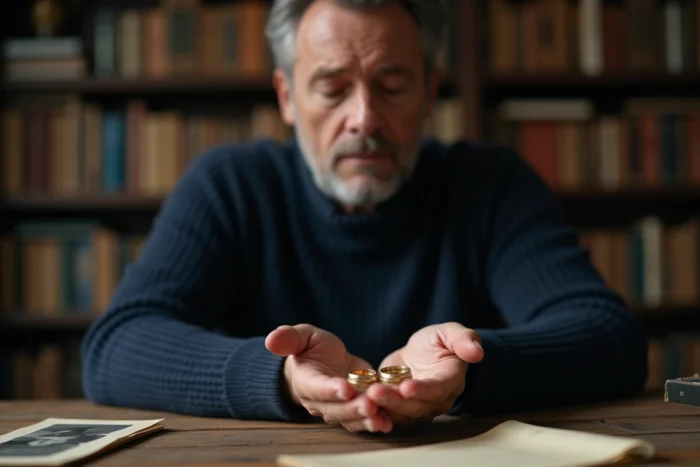
When both parents have passed away, the question doubles. Wearing both rings on the same finger (one against the other) is a strong gesture but may be cumbersome in daily life depending on the thickness of the rings. Having both rings soldered by a jeweler is an alternative that preserves both metals in a single piece of jewelry.
Another approach is to wear one ring and transform the second into another piece of jewelry (a ring set with a stone, a pendant). This solution also avoids sharing conflicts when there are multiple heir children.
Adapting the ring without erasing its history
A parental ring often has several decades of history. The metal may be scratched, thinned, and the size rarely fits well. Before wearing it, a visit to a jeweler is essential to evaluate three specific points.
- The residual thickness of the metal: a very thin gold ring worn for forty years may have become fragile. A jeweler measures the thickness with a caliper to determine if resizing is possible without risk of breakage
- The inner engraving: many rings bear a date or initials. During resizing, the engraving may be altered. Ask in advance if it will be preserved
- Polishing: restoring shine to a dull ring is simple, but excessive polishing removes material. It’s better to start with a gentle cleaning using warm soapy water
Contemporary mourning jewelry: beyond mere wearing
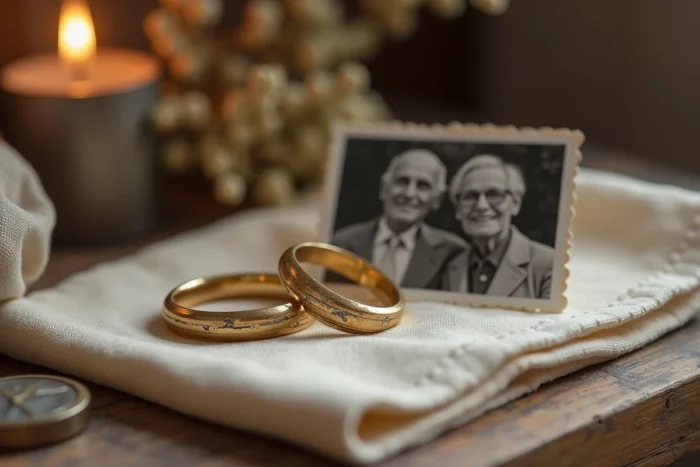
The trend for personalized mourning jewelry goes beyond simply wearing the ring on the finger. Some artisans offer to integrate a tiny amount of ashes into a locket or to cast the metal of the parental ring into a new shape (signet ring, band). These transformations allow multiple children to share a single original piece of jewelry by creating as many pieces as there are heirs.
These processes require a precise specification: the weight of recoverable metal, the original alloy (750 yellow gold, gray gold, platinum), and the desired type of finish. A detailed quote before any intervention protects against surprises.
Family and inheritance: anticipating tensions around the ring
The parental ring is part of the inheritance just like other assets. Under French law, family jewelry can be subject to preferential allocation during division, but this requires an agreement among heirs or a decision from the notary.
The topic deserves to be addressed early, ideally before the funeral. When a parent is nearing the end of life, they may express a wish for transmission themselves. In the absence of an expressed desire, the ring reverts to the overall estate. Proposing a duplication (melting and recreation) or a drawing of lots among siblings avoids the jewelry becoming a point of friction in an already difficult moment.
Wearing the ring of one’s parents remains a deeply personal gesture. What makes it right is neither the chosen finger nor the tradition followed, but the clarity of the intention behind the wearing. A ring passed down with an awareness of its family history retains its symbolic weight, regardless of the form it takes.