
Weight loss herbal tea, detox infusion, green tea fat burner: promises abound in organic aisles and online. To gain clarity, one must first look at what recent clinical studies say about the best-selling plants, and then compare their actual mechanisms on metabolism, water retention, and appetite.
Mechanisms of action of weight loss plants: what research really measures
Most weight loss herbal teas rely on three families of supposed mechanisms: thermogenesis (increased energy expenditure), drainage (water elimination), and appetite reduction. Not every plant covers all three.
The problem is that the majority of studies focus on concentrated extracts (capsules, powders standardized in catechins or caffeine), and not on a simple cup of infusion. The concentration of active ingredients in an herbal tea is much lower than that of a standardized extract. This discrepancy between research protocols and daily consumption explains much of the disappointment.
To know which weight loss herbal tea to choose, it is therefore necessary to distinguish the documented effects on extracts from those that can reasonably be expected from a classic infusion.
Weight loss herbal tea and weight loss: comparative table of studied plants
The table below summarizes the available data for the most common plants in weight loss herbal teas, specifying the main mechanism and the level of evidence.
| Plant | Main mechanism | Level of evidence (infusion) | Note |
|---|---|---|---|
| Green tea | Thermogenesis (catechins + caffeine) | Low in infusion, moderate in extract | Meta-analysis of 59 trials: real effect but clinically modest on weight and BMI |
| Matcha | Thermogenesis (concentrated catechins) | Low to moderate | Higher concentration of catechins than infused green tea as the whole leaf is consumed |
| Guarana | Metabolic stimulation (caffeine) | Low in herbal tea | Often combined with green tea in commercial blends |
| Peppermint | Reduction of bloating, digestion | Moderate for digestive comfort | No direct effect on fat mass |
| Fennel | Drainage, reduction of water retention | Traditional, few clinical trials | Flat stomach effect related to decreased gas |
| Dandelion / Orthosiphon | Diuretic (water elimination) | Moderate for drainage | Water loss, no fat loss |
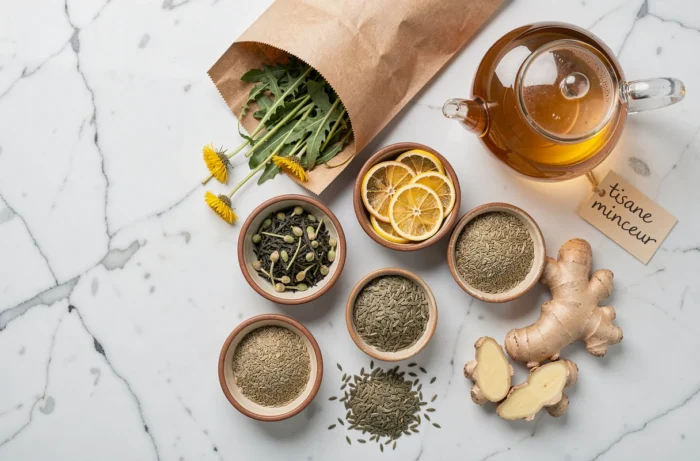
This table highlights a point often overlooked: no plant in infusion has a high level of evidence for fat mass loss. The most solid results concern digestive comfort and drainage.
Green tea and matcha: data from recent meta-analyses
Green tea is the most studied plant in the context of weight loss. A systematic meta-analysis of 59 randomized trials, published in the British Journal of Nutrition in 2024, confirms a significant but small reduction in weight, BMI, and percentage of fat mass. No measurable decrease in total fat mass was observed, and appetite hormones (leptin, ghrelin) are not altered.
The Cochrane systematic review on green tea for overweight adults goes further: weight loss induced by drinking green tea is statistically non-significant. No relevant clinical impact, either on weight loss or on weight stabilization after weight loss.
Matcha, on the other hand, presents a slightly different profile. The ground tea leaf is consumed in its entirety, which increases the amount of catechins ingested compared to a filtered infusion. However, no specific meta-analysis on powdered matcha allows for quantifying a net advantage over classic green tea.
Caffeine and catechins: the active duo
The thermogenic effect of green tea relies on the combination of catechins and caffeine. Taken separately, these molecules show even weaker results. This explains why caffeine-free herbal teas (rooibos, chamomile) have no measurable effect on energy expenditure.
Drainage and flat stomach: distinguishing water loss from fat loss
Herbal teas made from dandelion, orthosiphon, or cherry stalks are marketed as detox solutions. Their diuretic action is real: they increase urinary volume and reduce water retention in the short term.
This weight loss on the scale can reach a few hundred grams, sometimes more in individuals prone to water retention. This reduction concerns water, not adipose tissue. As soon as hydration returns to normal, weight comes back.
Carminative plants (fennel, peppermint, anise) act on another lever: the reduction of intestinal gas and bloating. The flat stomach effect is noticeable, especially after meals, but it relates to digestive comfort rather than fat loss.
- Dandelion and orthosiphon: documented diuretic effect, useful in cases of temporary water retention, with no action on fat mass
- Fennel and peppermint: reduction of bloating and improvement of digestion, contribute to a visually flatter stomach
- Guarana and green tea: slight stimulation of metabolism via caffeine, but limited effect in infusion form compared to standardized extracts
Concrete criteria for choosing an effective weight loss herbal tea
Rather than seeking the miracle plant, it is more useful to identify what you expect from a herbal tea in your weight loss journey.
- Goal of reducing bloating: prioritize blends based on fennel, peppermint, or green anise, to be consumed after meals
- Goal of occasional drainage: dandelion or orthosiphon infusions are suitable for a few days, without extending beyond two weeks without medical advice
- Goal of light metabolic support: organic green tea or matcha provide catechins and caffeine, provided not to exceed three cups per day to limit caffeine effects on sleep
- Goal of replacing sugary drinks: any herbal tea without added sugar fulfills this function, and it is probably the most reliable weight loss lever in this entire category

Choosing organic leaves ensures the absence of pesticide residues, a relevant criterion when consuming several cups a day over several weeks. Also check the ingredient list: some commercial weight loss herbal teas contain senna or buckthorn, laxative plants whose prolonged use can cause serious digestive disorders.
Replacing sodas and sugary juices with herbal tea remains the best-documented weight loss benefit, far beyond any fat-burning effect attributed to a specific plant. The most rigorous meta-analyses confirm that herbal teas accompany a comprehensive approach, without ever replacing it.