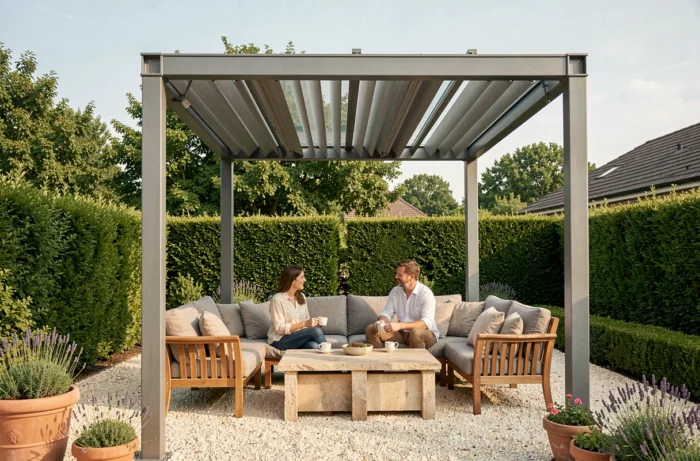
A bioclimatic pergola is an outdoor structure equipped with adjustable aluminum slats that allow for the regulation of light, ventilation, and protection against rain. The mechanism relies on the variable inclination of the slats: when flat, they create a waterproof shaded area, and when tilted, they allow air and sunlight to pass through.
This simple mechanical principle conditions the entire subsequent choice, as the quality of regulation directly depends on the precision of rotation and the thickness of the slats.
Attached or freestanding bioclimatic pergola: primarily an urban planning question
The first consideration is not aesthetic but regulatory. The thresholds for prior declaration and building permits differ depending on whether the pergola is attached to the facade or freestanding in the garden. The increased threshold that exempts from building permits does not systematically apply to new freestanding constructions, which many installers fail to specify.
In co-ownership, the constraint is even stricter. An attached bioclimatic pergola alters the exterior appearance of the building and requires a vote in the general assembly, even for a small area. As long as the sides remain open, the structure is legally considered an open work, which avoids taxation as a closed surface.
Closing the side walls with blinds or glazing changes this status and may trigger a dispute with the property manager.
To explore available configurations and installation options, specialized manufacturers offer detailed catalogs at https://www.need-sun.fr/ with both attached and freestanding models.
Checking the local urban planning plan of the municipality before signing a quote remains the first concrete step. An installer who does not ask this question upfront likely does not have experience managing administrative files related to this type of structure.
Adjustable slats: thickness, geometry, and precise rotation
All guides mention adjustable slats, but the quality difference between two bioclimatic pergolas hinges on three specific technical parameters.
- The thickness of the slat determines its rigidity against wind and its acoustic insulation capacity under rain. A slat that is too thin vibrates and amplifies the sound of raindrops, a defect that several users report after installation.
- The geometry of the profile (flat slat, S-shaped slat, elliptical slat) determines the watertightness when closed. S-shaped profiles fit together better and limit lateral infiltrations, while flat slats offer a cleaner look but require more efficient peripheral seals.
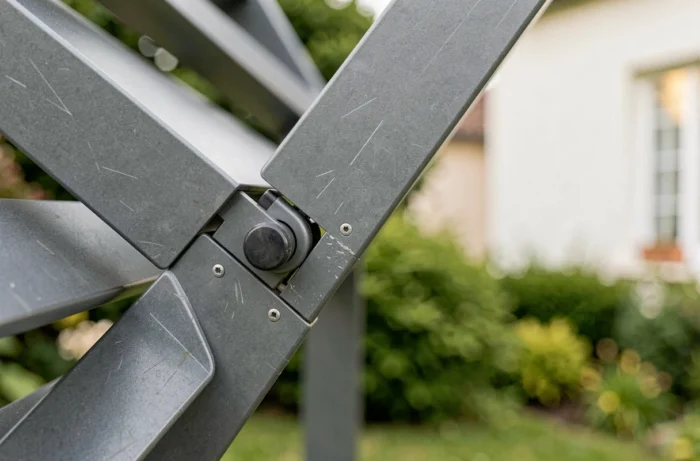
- The precision of rotation distinguishes high-end models. A degree-adjustable orientation allows for fine-tuning of ventilation and shading according to the sun’s path. Fixed notch mechanisms (three or four positions) limit this flexibility.
The rotation mechanism itself deserves attention. Metal linkage systems withstand the test of time better than plastic gears, but they are more expensive. A good indicator: the specific warranty on the rotation mechanism, separate from the general warranty of the structure.
Noise under rain: an underestimated criterion
The acoustic comfort of a bioclimatic pergola directly depends on the thickness and filling of the slats. Slats with insulating cores (foam or internal honeycomb) significantly reduce resonances. This point is rarely tested in showrooms, where weather conditions are not reproducible. Asking the manufacturer for details about the internal composition of the slat helps anticipate this defect.
Aluminum for bioclimatic pergola: why this material dominates the market
Aluminum has established itself as the reference material for bioclimatic pergolas, and this choice is not only aesthetic. Its resistance to corrosion makes it suitable for coastal or humid environments without regular treatment. Its weight-to-rigidity ratio allows for wide spans with reduced section posts, preserving the visual field from inside the house.
Powder-coated aluminum requires no structural maintenance beyond occasional cleaning. Current finishes offer matte, satin, or wood-like textures that blend with most facades. Wood, sometimes offered as an alternative, requires annual maintenance (staining, fungicide treatment) and does not withstand the mechanical stresses of motorized adjustable slats as well.
Galvanized steel is available on some entry-level models. It is heavier, more susceptible to oxidation over time, and less compatible with integrated motorization systems. For a bioclimatic pergola designed to last, aluminum remains the most coherent technical choice.
Motorization and control: what changes daily comfort
A manual bioclimatic pergola operates with a crank that activates the rotation of the slats. The system is reliable and inexpensive, but it requires getting up for every weather change. Motorization transforms the use: the slats automatically close in case of rain thanks to an integrated weather sensor.
Three levels of control are available on the market:
- Radio remote control: the most common, reliable, without dependence on the Wi-Fi network.
- Smartphone app: allows remote control of the pergola, convenient for second homes or seasonal rentals.
- Automatic sensors (rain, wind, sun): the slats adjust without human intervention. The anemometric sensor is particularly useful, as it closes the slats before a gust can damage them.
The additional cost of motorization with sensors represents a fraction of the total budget for the pergola, but it protects the investment in the long term. A mechanism damaged by wind costs much more to repair.
Ten-year warranty: a legal point to check
A recent decision has reclassified certain bioclimatic pergolas as building equipment elements, bringing them under the scope of the ten-year warranty. This qualification depends on how they are fixed to the existing structure. An attached pergola, bolted to the facade, is more likely to be covered than a freestanding model simply placed on plates. Requiring a ten-year insurance certificate from the installer before the start of work protects against structural defects.
The choice of a bioclimatic pergola commits for several decades. Checking urban planning compliance, testing the mechanical quality of the slats, and ensuring the installer has ten-year coverage are the three points that separate a successful purchase from an expensive dispute.