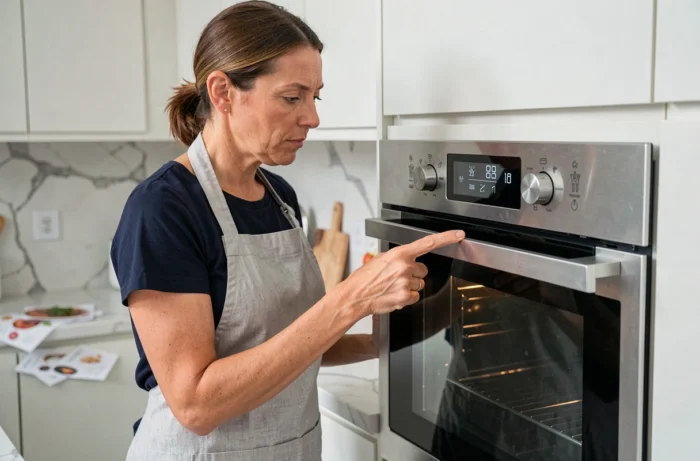
You turn the selector of your oven and come across a pictogram with a propeller, a line at the top, a line at the bottom, sometimes all three combined. The dish ends up too dry or not golden enough. The problem rarely lies with the recipe: it’s the cooking mode chosen that doesn’t match the expected result.
Each symbol on the control panel describes a specific heating circuit. Understanding this logic allows you to choose the right setting the first time, without fumbling between positions.
Static heat or convection heat: two cooking logics to distinguish
Before detailing each pictogram, it’s essential to grasp the fundamental difference between the two families of modes. Static heat heats by direct radiation, from the vault (top heating element), the sole (bottom heating element), or both. The air remains still inside the chamber.
Convection heat, on the other hand, adds a fan that circulates hot air. The result: the temperature is evenly distributed across all levels. You can cook several dishes simultaneously without the flavors mixing.
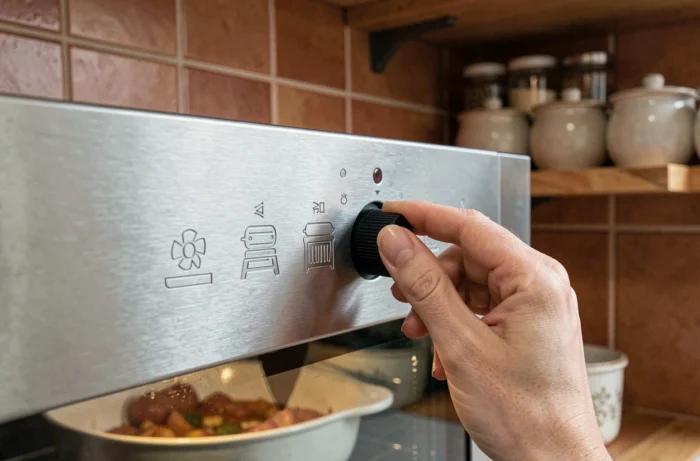
To decode the symbols and pictograms of the oven, keep this visual reference in mind: a horizontal line represents a heating element, a propeller represents the fan. The rest is just a combination of these two basic elements.
Reading common cooking pictograms without a manual
Have you noticed that the symbols look similar from one brand to another? That’s because they follow a graphic logic shared by most manufacturers. Here are the modes you will encounter on almost all ovens.
Line at the top and line at the bottom: natural convection
Two horizontal lines (one at the top, one at the bottom of the square) mean that the vault and the sole heat together without a fan. This is the so-called “traditional” or “natural convection” mode.
This setting is well-suited for dishes that require slow and enveloping cooking: gratins, lasagna, raised cakes. The heat rises naturally, which browns the top while cooking the bottom.
Propeller alone or propeller surrounded by a circle: convection heat
The propeller (sometimes in a circle) activates the rear fan. Some ovens combine this fan with a dedicated circular heating element: this is referred to as “stirred” heat (propeller alone) or “pulsed” heat (propeller in a circle with heating element).
Convection heat allows you to reduce the cooking temperature compared to natural convection, often by about twenty degrees for an equivalent result. This mode is ideal for pastries, cookies, and cooking on multiple levels.
Zigzag at the top: grill function
The zigzag (or wavy line) at the top represents the grill heating element. This mode heats intensely from above, at very high temperatures. It is used to gratin cheese, brown a crème brûlée, or finish cooking meat.
Two variants exist on some models:
- Small grill: only the center of the upper heating element activates, suitable for small surfaces like an individual gratin dish or toast
- Large grill: the entire upper heating element operates, covering the full width of the rack
- Grill with fan (zigzag + propeller): the fan distributes the grill heat, useful for roasting thick cuts of meat without burning the surface
Line at the bottom only: sole heat
A single horizontal line at the bottom of the square means that only the lower heating element heats. This mode is less common for everyday use, but it has a specific purpose: to finish cooking a pie crust or reheat a dish without browning the top.
Special oven symbols: defrosting, pyrolysis, and steam
Beyond the classic cooking modes, several pictograms correspond to additional functions that do not necessarily involve intense heat.
Snowflake or snowflake with drops: defrosting
This symbol activates the fan without heating the elements (or with very gentle heat). The air circulates around the food to accelerate defrosting evenly, without starting to cook the edges.
Diamond with the letter P or closed zigzag lines: pyrolysis
Pyrolysis raises the oven to very high temperatures to carbonize grease and food residues. During a pyrolysis cycle, the door automatically locks for safety reasons. This cleaning usually lasts over an hour and consumes a lot of energy.
Cloud or water drops: steam function
Present on newer ovens equipped with a water reservoir, this pictogram injects steam into the chamber. The steam keeps the moisture in breads, brioche, and certain vegetables. Some models combine steam and convection heat for a result that is both crispy on the outside and tender on the inside.
Energy label of the oven: regulatory pictograms not to be confused
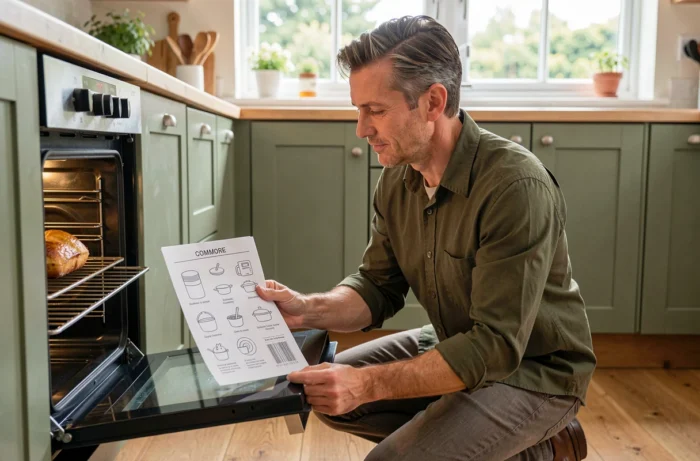
The symbols on the control panel describe cooking modes. The pictograms on the energy label attached to the appliance follow an entirely different logic: they indicate the energy performance and capacity of the oven.
Electric ovens still retain the old energy label model with classes A+++ to D, unlike most other household appliances that switched to the A-G scale since 2021. Do not confuse the energy class of the oven with its cooking modes: these are two distinct pictogram systems.
Since the 2021 reform, a QR code appears at the top right of the label. It links to the official EPREL database, where you can find the complete technical sheet of the appliance with its standardized consumption and capacity pictograms.
Adapting the cooking mode to the dish: concrete references
Knowing the meaning of each symbol is not enough if you don’t know which one to choose according to the dish. Here are the most reliable associations:
- Moist cake (cake, pound cake): natural convection, vault and sole, for even rising without drying out
- Pizza or thin tart: convection heat with reinforced sole if available, for a crispy base and evenly cooked topping
- Whole roasted chicken: ventilated grill or convection heat, which replicates the effect of a spit by browning all sides
- Dauphinois gratin: natural convection vault and sole, then switching to grill mode in the last minutes to brown the surface
Switching from one mode to another during cooking is a simple and effective technique. Starting with convection heat for even cooking, then switching to grill for finishing, often yields better results than using a single mode from start to finish.
The best reflex is to test the same dish with two different modes to see the difference. Once you associate each pictogram with a concrete result in your own oven, the mode selector becomes a precision tool rather than a source of confusion.